Investing for Children with ETFs: A Practical Guide from Birth to 18
Investing for children with ETFs: how a minor's custodial account works in Italy, what a monthly plan can reach in 18 years, and how it compares with savings.
Saturday, 21 November 2026

The christening envelopes
A baby is born and, within a few months, the envelopes start arriving: grandparents, aunts and uncles, godparents, colleagues. Parents end up with 2,000, 3,000, sometimes 5,000 euros earmarked “for the baby”. The most common move in Italy is to open a postal savings book and forget about it until the child turns 18.
It works, in the sense that the money stays put. But with interest close to zero and average inflation of 2% a year, after eighteen years that money buys about 30% less than it does today. Parents who try to do better soon run into a practical obstacle: you cannot buy an ETF in your child’s name through your own broker’s app. You need a dedicated account in the minor’s name, and it follows different rules from a standard account.
This guide explains how investing for children works in practice: which tools are available, what changes when the account belongs to a minor, how much a small monthly plan can be worth after eighteen years, and what happens when the child comes of age.
Investing for children with ETFs: why the time horizon changes everything
Almost every financial goal an adult has comes with an uncertain or fairly short horizon: a house in five years, a car in three, retirement in twenty or thirty but with contributions that stop if you lose your job. Saving for a newborn is different. The horizon is at least eighteen years, often longer if the money is meant for university or a first home, and nobody needs it in the meantime.
That detail has huge consequences. Equity volatility is frightening because a single year can cost 30% or 40%, as in 2008 or March 2020. Over eighteen years, though, the historical data on global stock markets tell a different story: since 1970 there has been no eighteen-year period in which the MSCI World index, with dividends reinvested, ended with a loss in nominal terms. That guarantees nothing about the future, but it shows that time works in favour of those who can wait.
This is why a mostly or fully equity allocation, which would be reckless for a 60-year-old, is a defensible choice for money set aside for a newborn. The real risk is not a one-year crash but being forced to sell at the wrong moment. And a three-year-old has no reason to sell anything.
One caveat: the horizon shrinks as time goes by. A plan started at birth has eighteen years ahead of it; one started at age twelve has six. In the last three or four years before the money is needed, it makes sense to gradually shift part of the capital into less volatile assets, just as you would with any goal that has a deadline.
The custodial securities account: how it really works in Italy
A minor cannot sign contracts, so they cannot open an account on their own. The parents open it as legal representatives, but the account holder and the owner of the securities is the child, under the child’s tax code. Money paid in legally becomes theirs.
The Italian Civil Code (Article 320) distinguishes between acts of ordinary administration, which parents can carry out freely, and acts of extraordinary administration, which require authorization from the guardianship judge (giudice tutelare). Collecting capital and reinvesting it fall into the second category. In practice:
- depositing money into the minor’s account is always allowed;
- investing depends on the provider: some banks allow a savings plan in diversified instruments with no formalities, while others require authorization for the very first purchase of anything other than government bonds;
- selling and withdrawing almost always requires the guardianship judge’s authorization, which must be justified in the child’s interest (medical costs, education and similar).
Getting authorization is neither complicated nor expensive, but it takes time. The practical takeaway is clear: a minor’s account is the right place for money that will stay invested for a long time, not for money that might be needed for braces in two years.
Before choosing where to open the account, ask three things in writing: whether a securities account for minors is available, which instruments can be bought without authorization, and what the fixed costs are. The answers vary a lot from bank to bank, and some online brokers simply do not offer this service.
Savings book, postal bond for minors or ETF savings plan: the comparison
The three most common options in Italy have very different profiles.
| Savings book (libretto) | Postal bond for minors | Savings plan in a global equity ETF | |
|---|---|---|---|
| Return | Close to zero | Fixed, known at purchase | Variable, historically higher |
| Risk of nominal loss | None | None (state guarantee) | Yes, especially in the short term |
| Taxation | 26% on interest | 12.5% | 26% on capital gains |
| Stamp duty | €34.20 a year above an average balance of €5,000 | Exempt up to €5,000 in postal bonds overall | 0.20% a year on the value |
| Inflation protection | None | Partial | Historically good over the long run |
| Flexibility | High | Early redemption possible, at a lower return | Sales require authorization |
The savings book is useful for small amounts that might be needed soon. As an accumulation tool over eighteen years it will almost certainly lose purchasing power.
The Buono dedicato ai minori, the postal bond for minors issued by Poste Italiane, deserves more attention than it usually gets. It matures on the child’s 18th birthday and its rate rises with the holding period: in the autumn 2026 issues, the yield to maturity reaches up to 5% a year gross for bonds bought in the first years of the child’s life. It is taxed at 12.5%, like government bonds, and within certain limits it is excluded from the ISEE, Italy’s household means test. At these rates it is a serious contender, provided it is held to maturity. Rates change with every issue, so check them at the time of purchase.
The savings plan in a global equity ETF offers the highest expected return, but with no guarantee. It is the only one of the three options where, in an unfavourable scenario, the final amount could be lower than the total paid in.
A worked example: 100 euros a month for 18 years
Take a parent who pays in 100 euros a month from the child’s birth to age 18: 216 contributions, 21,600 euros in total. Let’s compare a savings book paying 0.5% with a savings plan in a global equity ETF under three annual return assumptions, net of fund costs:
- 4%: a cautious scenario, below the long-term historical average of global stock markets;
- 6%: the central scenario, close to the historical return of a global equity portfolio in euros;
- 8%: a favourable scenario, similar to what some particularly good eighteen-year periods have delivered.
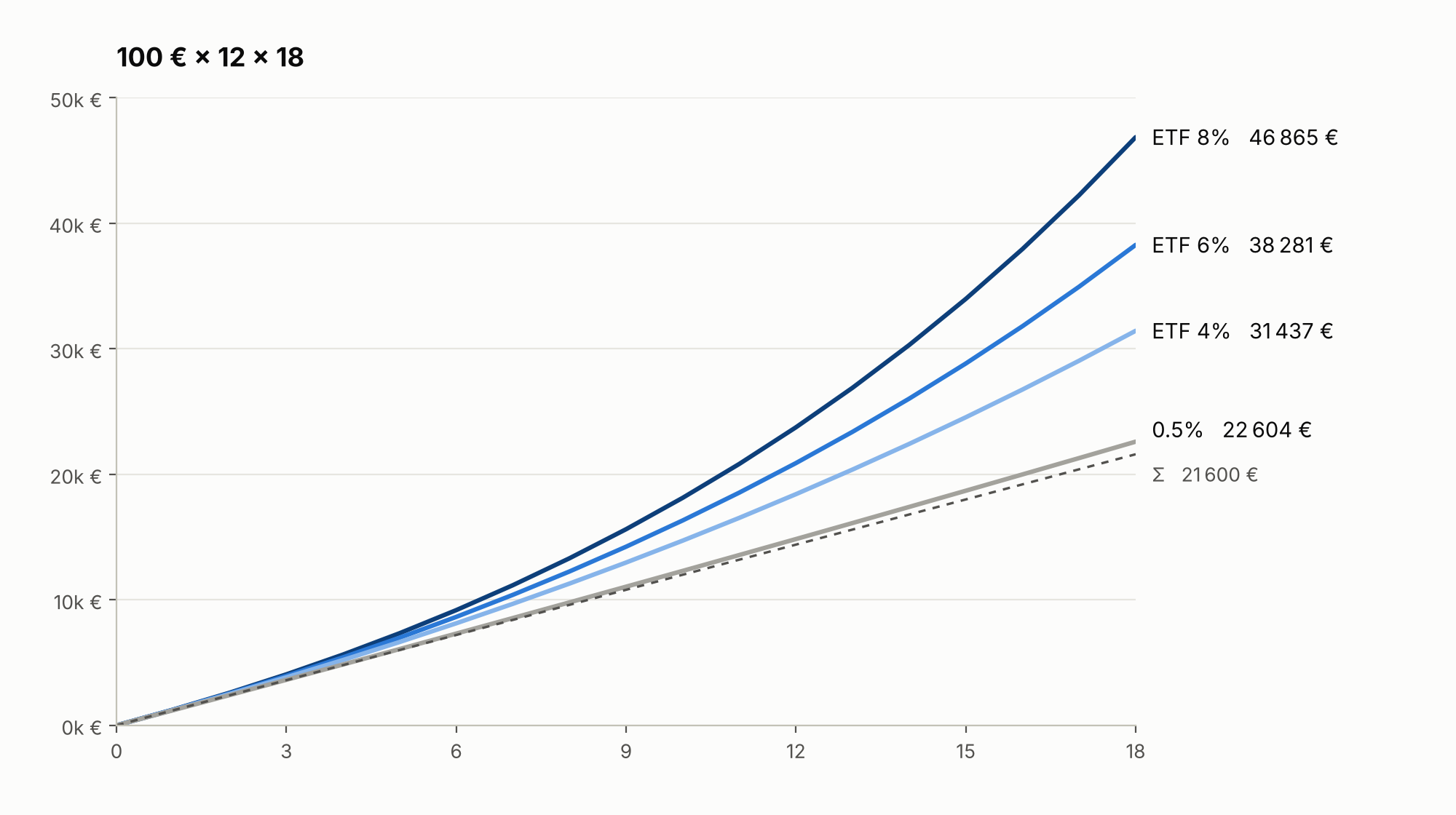
The final amount is calculated with the future value of an annuity formula:
$$FV = R \cdot \frac{(1+i)^n - 1}{i} \cdot (1+i)$$
where $R$ is the monthly contribution, $i$ the equivalent monthly rate and $n$ the number of months. Applied to the four scenarios:
| Scenario | Gross amount at 18 | Net amount after 26% tax on gains |
|---|---|---|
| Savings book 0.5% | €22,604 | about €22,340 |
| ETF 4% | €31,437 | €28,880 |
| ETF 6% | €38,281 | €33,944 |
| ETF 8% | €46,865 | €40,296 |
In the central scenario the ETF plan leaves the child about 11,600 euros more than the savings book, for exactly the same contributions. The most important figure, however, is a different one. With average inflation of 2%, the 22,340 euros in the savings book are worth about 15,600 euros in today’s money by age 18: the child receives less than what was set aside for them. The 33,944 euros from the central ETF scenario are worth about 23,800 euros in today’s money, so they preserve and grow purchasing power.
These figures do not include the 0.20% annual stamp duty on the securities account, which in the central scenario trims the result by a few hundred euros, nor any custody fees or trading commissions. With a 100 euro monthly plan, those can weigh heavily if the provider charges a fixed fee per purchase. A 5 euro fee on a 100 euro contribution throws away 5% every month. Before choosing an account, this is the first thing to check.
What about a lump sum?
The comparison changes when everything is invested at once. With 3,000 euros at birth, a postal bond for minors at 5% gross returns about 6,690 euros net at age 18. An equity ETF returning 6% delivers about 7,120 euros net. In the central scenario the gap is small, and the bond gets there with no risk at all. For a risk-averse parent, combining the two makes sense: the bond for the initial lump sum, the ETF plan for the monthly contributions.
Taxes: what changes when the account is in the child’s name
As far as tax rates go, nothing. ETF capital gains are taxed at 26%, government bonds and postal bonds at 12.5%, exactly as for an adult. For the details of how ETFs are taxed, see our guide to ETF taxation in Italy .
The differences lie elsewhere, and some of them favour the account held in the child’s name.
The tax position is separate. Any capital losses on the child’s account stay in the child’s own loss carry-forward (the zainetto fiscale) and do not mix with the parents’ losses.
The money already belongs to the child. Capital that has grown in the minor’s account is not part of the parents’ assets. It will not need to be transferred later through a gift and will not be part of the parents’ estate. Gifts from parents to children in Italy are exempt from tax up to one million euros per child, so the issue is rarely a tax one, but clear ownership from day one avoids arguments and paperwork.
The ISEE needs to be considered. The financial assets of children living in the household count toward the family’s ISEE. Government bonds and postal bonds benefit from an exclusion up to 50,000 euros in total; ETFs do not. For families applying for means-tested benefits, such as scholarships or reduced fees, this is worth weighing.
The alternative: invest in your own portfolio, with a label
Many parents take a simpler route: they invest in their own name and keep track of a share “earmarked” for the child. It is a legitimate approach, with clear pros and cons.
| Account in the minor’s name | Share of the parent’s portfolio | |
|---|---|---|
| Ownership | The child’s | The parent’s |
| Selling and withdrawing | Requires the guardianship judge’s authorization | Unrestricted |
| Choice of provider | Limited | Any broker |
| Costs | Often higher | Those of your own account |
| Transfer to the child | Automatic at 18 | A future gift |
| Risk of “borrowing” the money for something else | Low | High |
The last row matters most. Flexibility is an advantage only if you have the discipline not to use it. Money for your child held in your own portfolio is also money available for unexpected bills, a new car or a renovation. If you choose this route, use a separate account or securities deposit and track that share as a portfolio in its own right.
What happens at 18
On the 18th birthday the account passes into the child’s full control. The parents lose all signing authority, and the young adult can sell everything that very day without asking anyone.
That is why the money alone is not enough: there needs to be a plan. It includes deciding how to talk about it (many families start around 14 or 15, showing how the account has performed), sharing the purpose (university, a home, starting a business) and the basic education needed to understand what they own. An 18-year-old who receives 35,000 euros without ever having seen a statement will make very different decisions from one who has followed their own plan for years and has watched a 20% drop recover within a few years.
This may be the most underrated value of investing for children: not just the money, but the example. A child who grows up watching compound returns at work learns something school is unlikely to teach them.
Which ETF to choose
For an eighteen-year horizon the most consistent choice is also the simplest: an accumulating global equity ETF, which reinvests dividends automatically without generating taxable income to manage. An ETF on the MSCI World or, for even broader diversification, on the MSCI ACWI or the FTSE All-World, with a TER below 0.25% a year, covers thousands of companies across dozens of countries in a single instrument.
Adding more ETFs, sector or thematic ones, rarely improves the outcome for a goal like this and makes management more complicated, especially on an account where every sale needs authorization. For the logic behind a simple, low-maintenance portfolio, our guide to the lazy portfolio is a good starting point.
Finally, be careful with the “for your children” insurance policies sold by banks and insurance agents: they are often investment insurance products with annual costs well above those of an ETF. Over eighteen years the difference can be worth thousands of euros. The comparison is covered in depth in our article on unit-linked policies and ETFs .
FAQ
Can I set up an ETF savings plan in my underage child’s name?
Yes, through a securities account held in the minor’s name and opened by the parents as legal representatives. Not every bank or online broker offers one, and the rules on which purchases are allowed without the guardianship judge’s authorization vary from one provider to another.
Do I need a guardianship judge’s authorization to invest a minor’s money in Italy?
Not to deposit money. To sell securities and withdraw cash, almost always. For new purchases it depends on the bank: some require authorization for anything other than government bonds, while others allow an ETF savings plan without formalities.
Is the Poste Italiane bond for minors better than an ETF savings plan?
It depends on your risk tolerance. The bond pays a fixed, guaranteed return that is attractive today if held to maturity. An ETF plan has a higher but uncertain expected return. Many families combine the two: the bond for the initial lump sum and the ETF plan for monthly contributions.
How much can 100 euros a month for 18 years grow to?
With total contributions of 21,600 euros, the final net amount ranges from about 28,900 euros at a 4% annual return to about 40,300 euros at 8%, before stamp duty. In the central 6% scenario it comes to roughly 34,000 euros net.
Do savings held in a child’s name count toward the Italian ISEE?
Yes. The financial assets of children who belong to the household are included in the ISEE calculation. Government bonds and postal bonds benefit from an exclusion up to 50,000 euros in total, while ETFs are counted in full.
Next step
Investing for children does not take large sums. It takes starting early, choosing a simple, low-cost instrument and letting time do the work, since time is the one resource a newborn has in abundance.
With Wallible you can:
- Simulate a savings plan in a global ETF over an eighteen-year horizon and see how returns and drawdowns change across different historical scenarios
- Track your child’s account as a separate portfolio, with its own risk metrics
- Dig into the choice between regular contributions and a lump sum with our article on lump sum vs DCA
- Try the free ETF portfolio simulator to compare different combinations of instruments
Related guides
Robo-advisors in Italy: Are They Worth It Compared to a DIY ETF Portfolio?
Robo-advisor or DIY ETFs in Italy? Real costs, compounding math, 40,000-euro comparison over 20 years. When a …
Behavioral Finance: The Cognitive Biases Destroying Your Investment Returns
Loss aversion, recency bias, overconfidence: the cognitive biases that cost investors 2-3% per year. How to recognize …
Unit-Linked Life Insurance vs ETFs: What They Really Cost and When Insurance Makes Sense
Unit-linked life insurance vs ETFs: the Bank of Italy measured the cost gap. Real benefits, the term life + ETF …